Subsynchronous Oscillation Module
The Subsynchronous Oscillation Module analyzes a high-speed numerical input and detects subsynchronous oscillations in the 0–50 Hz range. This module helps identify electrical oscillations that can signal potential mechanical resonance or system instability.
Module icon

Overview
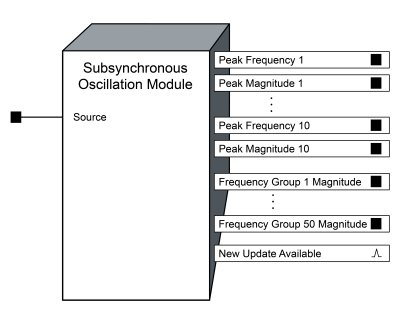
The Subsynchronous Oscillation Module is a high-speed module that performs a frequency transformation on a numerical input and finds peak oscillations. It analyzes the full sub-synchronous spectrum (0–50 Hz), and then finds the top ten peak magnitudes and the associated peak frequencies. You can also define frequency groups for which the module will report each group's RMS magnitude.
Inputs
 Source
The high-speed data that the module analyzes for subsynchronous oscillations.
Setup registers
 Frequency Groups
Defines the frequency ranges for which module will calculate RMS magnitudes. Resulting calculations are reported in the Frequency Group 1–N Magnitude output registers. You can enter frequencies between 0–50 Hz, inclusive. You can configure up to 50 groups. Group frequency ranges can overlap; each group reports its own results.
Enter frequency groups using the following format and rules:
-
Each group must be enclosed in square brackets.
-
Each group has a lower and upper frequency bound (in Hertz).
-
The lower and upper frequency bound must be separated by a comma.
-
Enter up to one decimal place per frequency bound; for example, 11.5. If you enter more, the value is truncated to one decimal place. For example, 11.567 becomes 11.5.
-
If only one bound is entered, the other bound defaults to the minimum (0 Hz) or maximum (50 Hz) allowed frequency. For example,
[5.0,]becomes[5.0,50]and[,10.5]becomes[0,10.5].Note: Enter at least one bound per group.
[,]is not valid.
-
-
Up to 600 characters.
Example input and interpretation
Example input: [0.1,49.4][10.0,11.567][5.0,][,10.5]
The module interprets this example input and assigns group numbers as follows:
| Input frequency group | Range analyzed by module (inclusive) | Group number |
|---|---|---|
[0.1,49.4]
|
0.1–49.4 Hz | 1 |
[10.0,11.567]
|
10.0–11.5 Hz | 2 |
[5.0,]
|
5.0–50 Hz | 3 |
[,10.5]
|
0–10.5 Hz | 4 |
Note: The module will include the bounds in RMS magnitude calculations except the 0 Hz (DC) frequency component.
Output registers
Peak 1–10 Frequency and Peak 1–10 Magnitude
These registers report the top ten frequencies and magnitudes detected within the full spectrum (0–50 Hz), ranked by the highest to lowest magnitude. The module does not include the 0 Hz (DC) component when detecting peak magnitudes.
Key details:
-
Each register corresponds to one of the top ten frequency and magnitude components.
Note: If fewer than ten peak magnitudes are detected, the remaining registers report 0.
-
Frequencies are expressed in Hz.
-
Magnitudes are expressed in the same units as the Source input; for example, kW or amps.
-
Updated approximately every second based on the most recent 10-second sliding window.
-
Use these registers to identify dominant oscillatory components in the monitored signal.
-
The meter ignores peaks below the greater of these two thresholds:
-
A magnitude less than 0.1.
OR
-
A magnitude less than 0.1% of the sliding window’s average magnitude.
-
Example
| Register | Value | Description |
|---|---|---|
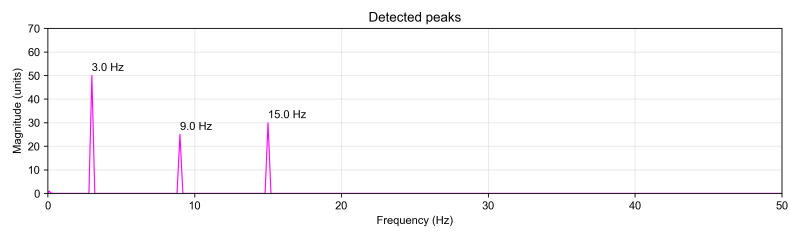
| Peak 1 Frequency |
3 Hz |
Frequency associated with the highest magnitude detected |
| Peak 1 Magnitude |
50 |
Highest magnitude detected |
| Peak 2 Frequency | 15 Hz | Frequency associated with the second highest magnitude detected |
| Peak 2 Magnitude | 30 | Second highest magnitude detected |
| Peak 3 Frequency | 9 Hz | Frequency associated with the third highest magnitude detected |
| Peak 3 Magnitude | 25 | Third highest magnitude detected |
| Peak 4–10 Frequency | 0 Hz | No additional peaks detected |
| Peak 4–10 Magnitude | 0 | No additional peaks detected |
Frequency Group 1–N Magnitude
The RMS magnitude for each frequency group as defined in Frequency Groups.
Note: If less than 50 groups were defined in Frequency Groups, empty groups will report N/A.
 New Update Available
This register generates a pulse every time the module completes a calculation and reports the values.
 Event
Event
All events produced by the module are written to this register.
Possible events and their associated priority numbers are shown in the following table:
| Event priority group | Priority | Description |
|---|---|---|
| Setup Change | 10 | Input links, setup registers, or labels have been changed. |
Detailed module operation
The Subsynchronous Oscillation Module continuously analyzes a numerical input to detect subsynchronous oscillations within the 0–50 Hz range. It uses a 10-second sliding window, recalculated every second.
How it works:
-
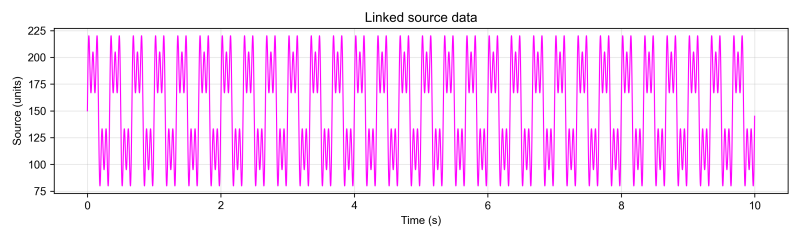
The module uses a 10-second sliding window of Source input data for analysis.
-
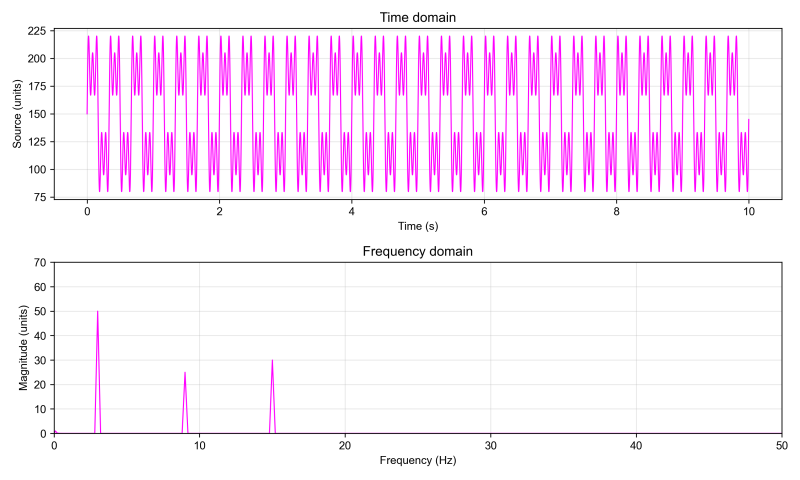
The module applies a frequency transformation across the subsynchronous spectrum (0–50 Hz), transforming the Source data from the time domain to the frequency domain.
-
The module identifies the ten frequency components with the highest magnitudes and calculates each component’s magnitude. It also calculates RMS magnitudes for all configured frequency groups.
The results are stored in:
-
Peak 1–10 Frequency
-
Peak 1–10 Magnitude
-
Frequency Group 1–N Magnitude
The New Update Available register pulses to indicate new data is available.
-
-
The calculation repeats every second using the most recent 10-second sliding window.
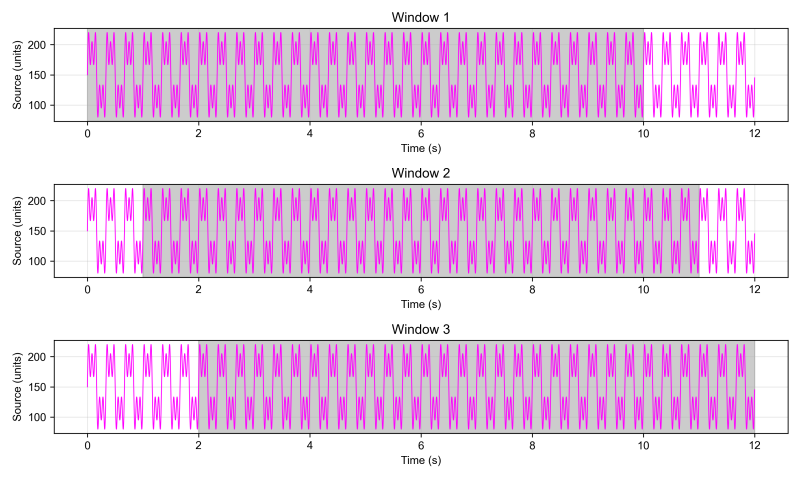
Note: There is a calculation delay between the update interval and when New Update Available is pulsed.
Responses to special conditions
The following table summarizes how the Subsynchronous Oscillation Module behaves under various conditions.
| Condition | Response of output registers |
|---|---|
| Module detects less than ten peak magnitudes. | The remaining Peak Frequency and Peak Magnitude registers report 0. |
| The first ten seconds after putting the module online or making a setup change. | Peak 1–N Frequency, Peak 1–N Magnitude, and Frequency Group 1–N Magnitude report N/A. |
| Less than 50 Frequency Groups are defined. | The Frequency Group 1–N Magnitude registers will report magnitudes for the defined Frequency Groups, remaining registers report N/A. |